

Egg freezing is one option for women who are not planning an immediate pregnancy or have medical conditions that may affect their ovaries.
At Queens IVF in Delhi, egg freezing is available as part of fertility preservation care. Understanding the appropriate age, procedure, benefits and limitations can help women decide whether this option suits their reproductive plans.
What Is Egg Freezing?
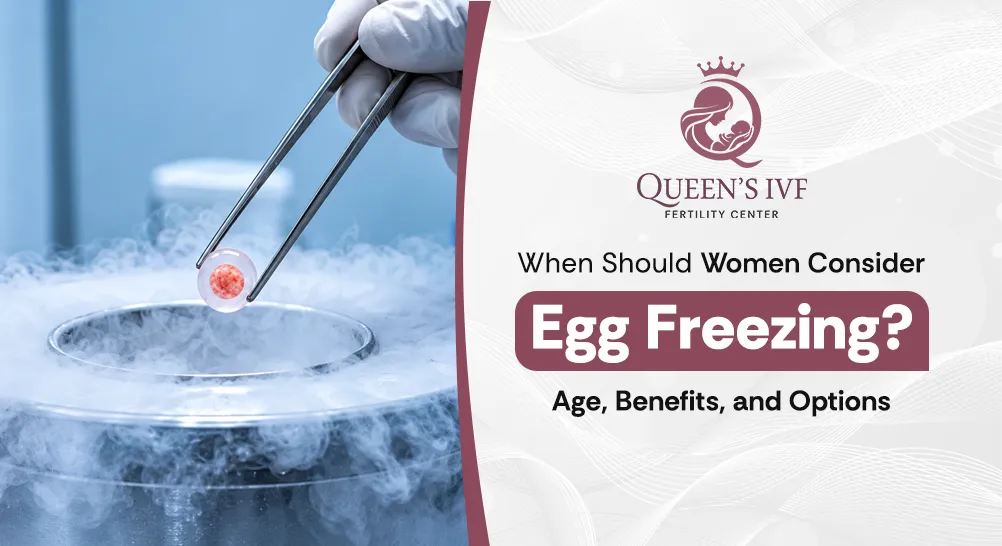
Egg freezing, medically called oocyte cryopreservation, is a procedure in which eggs are collected from the ovaries, frozen and stored for possible future use. The eggs are usually preserved through vitrification, a rapid-freezing technique that helps prevent ice crystal formation and damage to the egg cells.
When a woman decides to use her frozen eggs, they are thawed and fertilised in a laboratory through IVF. Egg freezing preserves eggs collected at a particular age. It does not stop the natural ageing of the ovaries or guarantee a future pregnancy.
When Should Women Consider Egg Freezing?
Egg freezing for women may be considered for medical reasons or when pregnancy is being postponed. The decision depends on age, ovarian reserve, medical history and future pregnancy plans.
1. Women Planning Pregnancy Later
Women who do not plan to conceive in the near future may consider freezing their eggs. Since egg quantity and quality generally decrease with age, freezing eggs earlier may provide another option if natural conception becomes difficult later. However, not every woman postponing pregnancy needs egg freezing.
2. Women Undergoing Cancer Treatment
Some cancer treatments, including certain chemotherapy medicines and radiation treatments, can damage the ovaries. Egg freezing may be considered before treatment begins. The fertility specialist and oncology team need to assess whether there is enough time and whether ovarian stimulation is medically appropriate.
3. Women With Conditions Affecting Ovarian Reserve
Women with endometriosis, particularly those who may need ovarian surgery, can discuss fertility preservation before treatment. Those with a family history of premature ovarian insufficiency may also benefit from an early fertility assessment. These conditions do not automatically mean egg freezing is necessary.
4. Women Who Prefer to Preserve Unfertilised Eggs
Some women prefer freezing eggs rather than embryos because they do not wish to use sperm at the time of preservation. This allows decisions about future fertilisation to be made later, within applicable medical and legal requirements.
What Is the Best Age to Freeze Your Eggs?
There is no single medically established best age to freeze your eggs. However, age at the time of freezing is an important factor affecting future outcomes. Egg quality and quantity generally decline as women get older, with the decline becoming more noticeable during the mid-to-late 30s.
Freezing eggs in the early 30s may offer better prospects than waiting until the late 30s or 40s. However, freezing eggs at a younger age does not guarantee pregnancy, and many younger women may never need to use their stored eggs.
Women considering egg freezing after 35 should understand that fewer eggs may be collected and more than one cycle may be necessary. The decision should consider both current fertility and the likelihood of needing the eggs in the future.
How Is Fertility Assessed Before Egg Freezing?
A fertility assessment helps doctors estimate how the ovaries may respond to stimulation medicines. Common investigations include:
AMH test: Measures anti-Müllerian hormone to estimate ovarian reserve.
Antral follicle count (AFC): Uses ultrasound to count small developing follicles in the ovaries.
Medical history: Reviews menstrual cycles, previous ovarian surgery and relevant health conditions.
These tests help estimate the potential number of eggs collected. They cannot reliably determine egg quality or guarantee future pregnancy.
How Does the Egg Freezing Procedure Work?
Egg freezing treatment generally involves ovarian stimulation, egg retrieval and laboratory freezing.
1. Ovarian Stimulation
Hormonal injections encourage several ovarian follicles to develop. Stimulation commonly takes around 10–14 days, although the duration varies. Ultrasound scans and blood tests help doctors monitor the response.
2. Egg Retrieval
Once the follicles are ready, eggs are collected using a thin needle guided by ultrasound. The procedure is usually performed under sedation or anaesthesia.
3. Freezing and Storage
Mature eggs are identified in the laboratory and frozen using vitrification. They are then stored at very low temperatures in specialised storage systems.
What Are the Benefits of Egg Freezing?
The main egg freezing benefits relate to preserving reproductive options rather than treating an existing fertility problem. Egg freezing may allow women to:
Preserve eggs before potentially fertility-damaging medical treatment.
Store eggs collected at a younger reproductive age.
Consider pregnancy later using previously frozen eggs.
Preserve unfertilised eggs without creating embryos immediately.
This makes egg freezing one option for fertility preservation for women. However, the possible benefit depends on the woman's age, the number of mature eggs stored and how those eggs perform when used.
Does Egg Freezing Guarantee Pregnancy?
No. Egg freezing does not guarantee pregnancy or a live birth. Not every egg survives thawing, fertilises successfully or develops into a suitable embryo.
The chance of pregnancy depends on age when the eggs were frozen, the number of mature eggs available, sperm factors, embryo development and uterine health. Pregnancy at an older age may also carry medical risks, even when younger eggs are used.
What Are the Risks of Egg Freezing?
Egg freezing involves fertility medicines and an egg retrieval procedure, so side effects and complications are possible. Common effects include abdominal bloating, mild discomfort, nausea and temporary pelvic pain.
Less common complications include ovarian hyperstimulation syndrome (OHSS), an excessive response to stimulation medicines. Egg retrieval also carries small risks of bleeding, infection and complications related to sedation or anaesthesia.
What Does Egg Freezing Cost in India?
The cost of egg freezing in India varies according to medication requirements, investigations, egg retrieval, laboratory freezing and storage fees. Some women may require more than one stimulation cycle to collect an appropriate number of eggs.
Future costs for thawing, fertilisation, embryo culture and transfer are generally separate. Patients should request an itemised estimate and understand the applicable storage duration, consent requirements and annual charges before proceeding.
Egg Freezing at Queens IVF in Delhi
Queens IVF offers egg freezing in Delhi at its Safdarjung Enclave location. Fertility assessment may include ovarian reserve testing, ultrasound examination and review of medical history before discussing preservation options.
If you are searching for an egg freezing clinic near me, consider the clinic's ART registration, laboratory arrangements, storage procedures, treatment costs and approach to informed consent.
Frequently Asked Questions
1. Can I get pregnant naturally after freezing my eggs?
Yes. Egg freezing does not prevent natural pregnancy or stop normal ovulation. Women may still conceive naturally after freezing their eggs, provided their reproductive function allows it. Stored eggs remain available for possible future use under the applicable consent and storage conditions.
2. Can women with low AMH consider egg freezing?
Yes, but the outcome depends on individual ovarian reserve and response to stimulation. Low AMH may mean fewer eggs are collected during a cycle. It does not independently predict egg quality or future pregnancy. A fertility specialist can explain whether egg freezing is reasonable.
3. How many eggs should a woman freeze?
There is no fixed number suitable for every woman. The number of mature eggs needed depends on age at freezing and reproductive goals. Some women may need more than one retrieval cycle. Even freezing several eggs cannot guarantee a live birth.
4. How long can frozen eggs be stored in India?
Egg storage in India is governed by assisted reproductive technology regulations and consent requirements. The applicable duration and any permitted extensions should be confirmed with the clinic. Patients should also ask about annual storage fees, consent renewal, and what happens if they no longer wish to store their eggs.
5. Can egg freezing delay menopause?
No. Egg freezing does not delay menopause or prevent the natural decline in ovarian function. It preserves eggs collected at a particular age for possible future IVF treatment. The ovaries continue ageing normally, and pregnancy using frozen eggs is not guaranteed.